a couple weeks ago, i started reading We Begin Here: Poems for Palestine and Lebanon. it was clear to me, after the introduction, that the content would be a devastating dive into painful reality, so i decided i would read a second book alongside it as a bit of a palate cleanser. Stay True by Hua Hsu had been on my want-to-read list for a while, and it didn’t stretch my funds too thin to purchase it, so i snagged a signed copy while on an outing with a friend. both books have already been profoundly impactful to me— as both an artist and a human— and i’m excited to share my thoughts with you based on what i’ve read so far. but first,
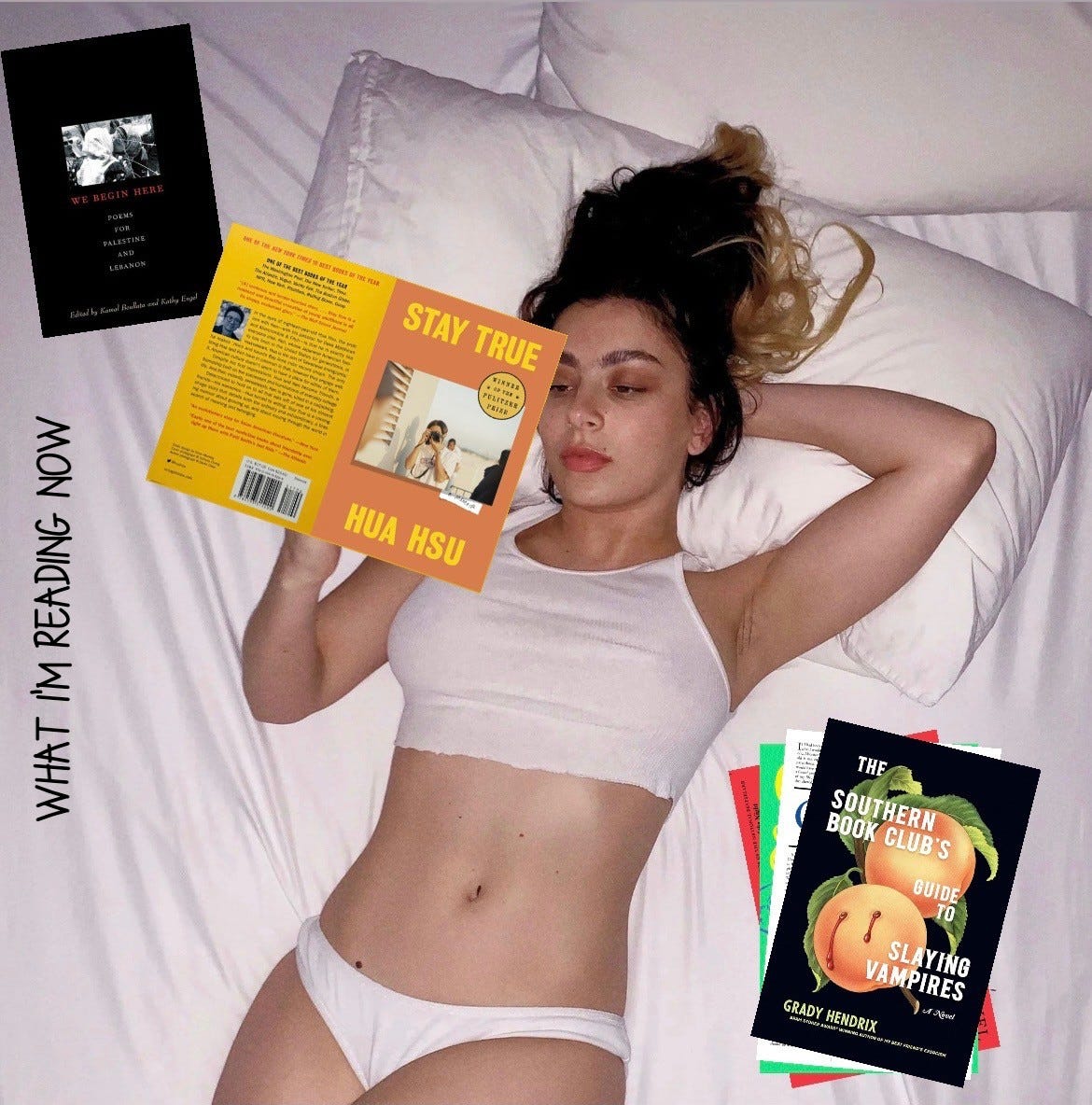
i have not read a piece of fiction so voraciously in quite a while. if you’re a fan of lightweight horror that makes your skin crawl but also pushes you to turn the page, then i highly recommend this piece from Hendrix’s lineup.
set in the late eighties to late nineties in the southern US, this story is packed with plot twists and moments that twist the stomach into knots. The Southern Book Club’s Guide to Slaying Vampires invites you into moments of outrage when men don’t believe women or when they choose to preserve their reputation over their connection to their wives. it presents the reader with the reality of Black communities being underserved and unprotected by the police and the white folks that they share spaces with.
i want you to read this book and don’t want to spoil the plot too much, so i’ll leave you with this:
if you want a creepy, vampiric, less white savior version of The Help or a more nineties housewife, less hot n’ heavy version of Twilight, read this story.
this anthology is comprised of two parts— a collection of poems written between 1982 and 2006 and a collection of poems written before 1982. all poems are centered around the atrocities that Israel has been and is still committing today. the editors put out part 2 for the first time in the eighties and felt it necessary to compile an additional collection of poems following Israel’s war on Lebanon in 2006.
as i said in my introduction, i am trying to take it slow and easy when it comes to reading through this work, but i am almost finished with part 1 and almost halfway through the entire collection. it should go without saying that the pieces within this collection are earth-shattering and heartbreaking, but i think the worst part— for me— is the knowledge that the apartheid state of Israel has been enacting terror upon not only Palestine, but the countries surrounding it for decades with impunity.
there is an opinion piece titled “The West made us pay for its guilt - and now watches as Israel delivers the final Nakba,” that Ghada Karmi wrote forMiddle East Eye. the title itself illustrates how the government has influenced our awareness of the ongoing genocide perpetrated by Israel, as well as how those in control (specifically in the US) continue to absolve themselves of fault. for the past 5 years, i have bore witness to the tragedies in Gaza and the West Bank, but reading this collection of poetry has deepened my understanding of how far back the violence of the zionist state goes and how disgustingly inhumane it is.
while most of the content of this collection acknowledges pain, the disastrous reality of indiscriminate bombardment, displacement, and multigenerational trauma, there is some beauty held within the remembrance of what came before Israel’s violent campaign.
it is my hope that Palestinians and the people of Lebanon return home and rebuild what their ancestors once knew.
so far, this memoir is a lesson in seeing the beauty in everyday moments. i have dog-eared many pages— inspiration for creative endeavors, ruminations on the importance and meaning of friendship, the idea of making oneself memorable and a permanent piece of history. Hsu’s memoir is a reminder to remain tuned in to those who love you, those you love, and why the love is there.
i know that at some point in this story, Hua Hsu’s friend dies, and i’ve yet to read that far— although i am halfway through reading the book. as much as this story is offering me a lot of important perspective, it is not entirely a lighthearted escape from the devastation of We Begin Here. i think that i may cry when i read about the friend’s demise.
all in all, i am glad that i picked up a copy of Stay True and think that i will be grateful to have read it. we could all use a reminder to love more deeply and fully and to remain grounded in the present and in our relationships.